Vodafone services: coming soon to a Socialist People's Arab Jamahiriya near you...
One African republic has been hitting the headlines recently, as the effects of a diplomatic row between that country and a European nation is now affecting citizens of many other states. This is a particularly thorny issue given that much European money has been poured into the construction and oil sectors of that North African nation. People carrying the passports of most major European economies are now prevented from travelling there. This must be causing great disruption to companies whose personnel usually need to spend time in the African state.
One giant global mobile business, however, seems to not to have been too seriously affected.
In July last year, DevelopingTelecomsWatch made some positive noises about the investment climate in Libya. While there was some head scratching about the attractiveness of the North African country's mobile market (mobile penetration was a hefty 141.58% at time of writing - it is 159.42% now, according to WCIS), it was noted that relations between the USA and the Colonel Gaddafi regime had improved to the point whereby foreign investors might not fall foul of restrictions set by the U.S. Treasury's Office of Foreign Assets Control.
More recently, however, relations between Libya and some western countries have once again become rather strained, causing Tripoli to stop issuing visa to citizens of the twenty-five European countries of the Schengen passport-free zone. At the centre of this dispute is Switzerland, which, according to a Libyan newspaper report of February 14th, had denied entry visas to nearly 200 Libyans, including Gaddafi, members of his family and other senior officials. As a helpful Reuters timeline explains, this Swiss move came after wrangles that had continued since June 2008, when police in Geneva arrested Hannibal Gaddafi, one of the Libyan leader's sons. Gaddafi jr., along with his pregnant wife, were taken into custody following allegations about the mistreatment of two of their employees.
By February 26th of this year, both the European Union and the United Nations felt forced to respond to Col. Gaddafi's subsequent call for jihad against Switzerland, announced as the row has escalated and become yet more bitter. By March 1st, analysts were commenting that the row has exposed weaknesses in Swiss foreign policy and damanged the country's reputation as an impartial global mediator.
Citizens of countries in the Schengen zone, meanwhile, continue to be refused entry to Libya.
From his name, I would hazard a guess that Mr. Colin MacDougall is either an Irish or a British citizen. As such, he would be a national of a country that has chosen to opt out of Schengen's border control arrangements. This would explain his recent present in Tripoli, representing Vodafone, on whose behalf he formalised a Partner Markets agreement with state-owned Libyan mobile operator Al-Madar.
MacDougall seems to work for the Partner Markets unit of the giant cellco, which enables subscribers of operators in which Vodafone has no equity to enjoy exclusive access to a range of products, services and devices from the UK-headquartered group. Partner operators also gain from Vodafone's experience in supply chain management, the acquisition of enterprise customers and improved network inter-working. In turn, Vodafone customers can gain from improved roaming arrangements in countries where Vodafone does not otherwise have a presence.
Over the last few years, I have had the pleasure of meeting several people attached to Vodafone Partner Markets and know that they work pretty hard to maximise the value of the numerous relationships they manage worldwide. In light of the recent wrangles, and keeping in mind the eccentricities of the state which owns Vodafone's latest MNO partner, one wonders whether this will be an especially challenging relationship to maintain. However, given that oil-rich Libya is of vital economic significance and that the Vodafone teams who run these partnerships appear to be so adept at meeting tough challenges, I daresay this will prove advantageous to the shareholders and customers of the global mobile group.
Two months have passed since that rash promise was made and not a peep has been heard from this once prolific blog - no fewer than 147 posts saw were published here in 2009.
Apologies, then, to anyone who has found DevelopingTelecomsWatch to be a useful source of news, commentary and speculation and who now wonders whether the blog has fizzled out of existence. Happily, for anyone that cares, this is not the case. That said, I do not expect to be writing anything like as often in 2010 than was the case last year. My commercial activities are, I am pleased to report, taking up far more time now, suggesting that this year will be more profitable than the one we have left behind us. I do hope that regular readers are facing this first year of a new decade with similar optimism.
Failure to deliver on good intentions notwithstanding, then, perhaps DTW and its writer are not on that proverbial road to hell.
What of our industry and its interests across emerging markets? Hellbound? Or good times ahead?
Belatedly, then, with two months of the new year having already passed, let's attempt to answer those questions by taking a look at a couple of the predictions made by the crystal ball gazers at Informa:
'So-called emerging markets will transition into a new phase of competition based on services and bring into question the validity of the term "emerging market" as it is understood in the telecoms sector today.'
Informa's report notes that "Until now, the term 'emerging market' in the context of the mobile sector has been used as a catch-all phrase to describe markets characterised by low penetration rates, a proliferation of mobile network operators, steep drops in the price of basic communications and resulting explosive mobile subscription growth."
This is familiar territory here at DTW. Numerous times, reference has been made to markets in which the price of mobile services has been squeezed down to a level that makes life very hard for some of the competing cellcos. In July last year, for example, this blog covered the decision of Millicom International Cellular to withdraw from all the Asian markets in which it once did business - Sri Lanka, Laos and Cambodia. The latter country certainly matches the Informa's report's reference to "a proliferation" of MNOs. No fewer than nine (!!) cellcos are currently fighting for business in a country with just 14.8 million inhabitants. Here they all are, with market share figures from Informa's WCIS product:
Cellcard (GSM, 42.12% market share - the operator in which Millicom had a stake)
Regular readers may have spotted that from time to time I like to share video clips of telecoms operators' TV advertisments from around the world. Latelz (AKA Smart Mobile), as the list above suggests, is one player that may need some pretty compelling advertising if it is to become a more significant player. You decide how powerfully the Smart Mobile case is made by these:
Cambodia is a pretty extreme case, perhaps, but DTW has also examined a number of African markets which seem to be ripe for mobile market consolidation. I daresay there are many more around the world in much the same state.
While I am insinctively in favour of competitive environments which offer value and choice to consumers of mobile services, I do also sympathise when I speak with employees of operators that are struggling to improve shareholder value in the context of dramatically slashed prices. These guys, it sometmes seems to me, can feel as if they are on that proverbial inferno-bound round. If Informa's prediction is on the money, however, perhaps that fiery destination need not be reached this year.
On to the next prediction with an emerging markets/developing countries angle...
'Mobile banking efforts will continue to proliferate in emerging markets, but in the short-term these will be more important as a customer acquisition and retention tool than as a genuine driver of significant new operator revenue streams.'
The efforts made to date in this area got some coverage here last year. In May we noted that giant cellco Bharti Airtel was looking to tap into the big opportunity presented by the fact that 85% of the citizens of its Indian home market do not have bank accounts. By August, readers were invited to consider whether mobile operators would necessarily dominate the market for mobile banking services aimed at turning a profit while going some way to alleviating the poverty of subscribers in developing countries. An alternative that we discussed was the possibility of operator-neutral solutions gaining traction.
The chaps at Informa were have not been alone in keeping discussions of this sort on the agenda for 2010. Indeed, mobile banking in emerging markets got a mention during the plenary session of last month's Mobile World Congress. Simon Rockman of the Register noted, however, with some distaste, "that transforming the lives of millions of people by giving them bank accounts – something that can make the difference between eating and starving - didn't garner the same round of applause" as that received by the GSMA project aimed at making every mobile phone use the same charger."
Writing up his notes from the Congress the following week, Rockman also wondered at some of the number crunching around the scale of the m-banking opportunity. He noted that day four of event saw an assembly of the mobile money working group that has received USD 12.5m from the Bill and Melinda Gates Foundation and is working towards the GSMA's target of getting 20 million of the billion people who have a mobile phone but do not have a bank account onto the first rung of the financial ladder.
Ignacio Mas, writes Rockman, gave a detailed account of what the Bill and Melinda Gates Foundation wants to achieve: "They wanted the very poor and insecure to be able to save", targeting people living on less than USD 2 per day. "As much as they have low subsistence incomes", reports Rockman, "the real problem is stability - they might only find work occasionally and have to eke out money until they next find work. Or if they are farmers they get paid seasonally at harvest time."
Without access to banks, continues Rockman, such people are very vulnerable: "They will often give the money to people they trust for safekeeping but these are people in a similar situation to themselves. Lack of stability means people get multiple jobs. They can't concentrate on what will get the best return and pull themselves out of poverty because they have to opt for stability."
This, and other challenges, blight the lives of so many people around the world that it does seem reasonable to suppose that a huge opportunity does exist for the telecoms industry to provide what the retail banking sector cannot in underdeveloped countries.
Well, I enjoyed finally finding the time to write something here after such a long hiatus - but will refrain from making rash promises about when the next article will appear. More soon, I hope, though.
Doing telco sector business in Turkey, the Caspian region or Central Asia? ......head for Eurasia Com at Istanbul's Conrad Hotel this March.
A belated Happy New Year to all loyal readers of (and occasional visitors to) DevelopingTelecomsWatch.
I daresay some of you will have found 2009 above-averagely challenging and are looking forward hopefully to a more prosperous and settled year ahead.
With this in mind, DTW will soon be evaluating some predictions about what 2010 may have in store for those of us with an interest in the telecoms sector in emerging markets and developing countries worldwide.
In the meantime, we will be using the announcement of the conference agenda for this year's Eurasia Com conference in Istanbul as the inspiration for a look around developments in Turkey, the Transcaucasus region and Central Asia. These are the markets from which the event gathers telecoms sector leaders for two days of discussions and networking.
My guess is that I will not be able to attend the conference - taking place at Istanbul's Conrad Hotel on 23-24 March - but I would definitely recommend it as a useful place to make new contacts and catch up with existing ones if you do business with the telecoms operators of that part of the world. I feel qualified to make this recommendation, having attended two iterations of the event, and having been involved in its development between 2006 and 2009.
This year's speaker panel includes a glittering array of telecoms leaders from both the host country and from numerous CIS markets. Those able to attend will have the opportunity gain a uniquely valuable opportunity to learn from these panellists - and some will doubtless advance their cases for doing business with the speakers' organisations.
While I daresay, however, that many of the presentations and public panel discussions will be somewhat insightful, my experience of attending many conferences has taught me that delegates can learn far more by being above-averagely proactive. This means being a real participant rather than a mere attendee. It means doing more than just scribbling/typing notes during the conference sessions. It means more than downloading the presentation slides.
So, if you make it to the Conrad Hotel in Istanbul, be sure to come prepared with the questions you particularly want answered. Then make the effort to direct those questions to relevant speakers, keeping in mind that however effectively the sessions are moderated, there will not be time for the Chair to deal with everyone who has something to ask. Should your most urgent questions not get dealt with, be sure to be one of those confident people seen springing from a front row seat to shake hands and exchange business cards with the hottest speakers the second the session breaks for strong Turkish coffee. Then might be the time you will finally make your point or extract the answers you're looking for. Or your possibly rather sensitive enquiry might best be handled over that coffee and a piece of sweet, flaky baklava. Failing that, the business card you've gained could be the key to setting up post-event conversations.
Question time: get the answers over coffee and Turkish treats at Eurasia Com
Does this all sounds like advice that's basic to the point of being a bit patronising? I hope not. It is, after all, offered as a result of having watched countless conference delegates fail to maximise the value of the investment their companies had made by paying for them to attend - even with the free tickets for which employees of telecoms operators and service providers are eligible at Eurasia Com and other Com World Series events, some costs are implied, be it plane tickets and hotel bills for out-of-town delegates, or just the cost of being away from the day job.
If you do decide to attend, and do attend on a mission to learn about developments in the region covered by the conference, what questions might you direct to the numerous worthies on the speaker panel?
Given that the CIS markets of Central Asia and the Transcaucasus region were among the first places that Russia's major telecoms players looked for international growth opportunities, you would hope that Eurasia Com is able to offer access to their top management. The event does not disappoint - gracing the stage for the opening Keynote Session will be Mustafa Kiral, Vice President of Altimo and Oleg Raspopov, who heads up the 'Foreign Subsidiaries' Business unit of giant Russian cellco MTS.
Any industry watchers with a strong interest in the latter company, might be tempted to try and squeeze in a question about the operator's hopes for its mobile broadband offering in Moscow, now that 3G services can finally be made available in the Russian capital. A full year after 3G services were offered in other parts of Russia, Muscovites learned last month that the country's military authorties were finally ready to cede control of the necessary spectrum and enable operators to switch on their W-CDMA base stations.
Given Mr Raspopov's responsibilities, however, and given the geographical coverage of the conference agenda, perhaps it might be more germane for delegates to ask the MTS man whether his company has any interest in further extending its CIS footprint. At present, MTS subsidiaries compete in Uzbekistan, Turkmenistan and Armenia. Away from the immediate focus region for this conference, further MTS business units operate in Ukraine and Belarus.
Strikingly absent from the MTS sphere of influence are two of the region's potentially more attractive markets - MTS does not compete in either Kazakhstan or Azerbaijan.
In June last year, MTS CEO Mikhail Shamolintold Reuters that his company was looking at acquisition opportunities in both countries, having decided that the prospects for a start-up operation were not good in either market.
It now appears, however, that the opportunity to make an acquisition in Kazakhstan has now passed. That country's mobile arena is contested by four operators, with the market split as follows, as of end-December 2009, according to the WCIS service offered by the organisers of Eurasia Com, Informa Telecoms & Media:
The two leading mobile operators, then, are controlled by MTS's main rivals in the region and are therefore, surely, extremely unlikely targets for addition to Mr Raspopov's Foreign Subsidiaries Unit. Altel, too, as a rare example of a CDMA operator in the region, strikes me as a company one cannot easily imagine on the MTS shopping list.
Neo, a late entrant GSM operator which went to market in 2007, would be the logical choice for an MTS purchase. A majority stake in this cellco, however, is to be snapped up by Tele2, the Sweden-headquartered pan-European telecoms group. This transaction, as reported in December, involves Tele2 paying around USD 77 million for the 51% stake held by Kazakhstan's incumbent fixed line operator, Kazakhtelecom, which also owns 49% of KCell. According to a Wall Street Journal report, Tele2 has the option to buy the remaining 49% of Neo shares in five years' time from private investment group Asianet Holdings BV.
It will now be interesting to see how much Tele2 makes of the opportunity that MTS has declined to puruse in Kazakhstan. Interesting, too, to see how far the company's usual preference for competing aggressively on price will impact on the Kazakh market.
Speaking on a conference call, Tele2 said that Neo currently has lower prices and lower ARPU than its two larger rivals, so it remains to be seen whether tariffs can be cut further in order to gain market share. According to the WSJ article, a market share of 20% is what Tele2 has in mind.
Of further CIS markets likely to prove attractive to MTS, perhaps only Azerbaijan remain. A June 2009 article here at DTW noted that the Caucasus region country, although quite small with a population of just under 9 million, is oil-rich and relatively prosperous. It is notable, therefore, that of the three groups with footprints across the southernmost CIS markets, only the TeliaSonera-Turkcell joint venture Fintur Holdings has a presence - in the form of market-leading MNO Azercell, none of whose competitors are aligned with a significant multinational telecoms groups. Of these competitors, one will be represented at Eurasia Com by its CEO - Ineke Botter, who heads up Bakcell, is among the speakers. A cheeky question one might direct to Ms. Botter would be to ask whether she feels either her company or the third entrant, Nar Mobile, is a likely acquisition target for MTS or Vimpelcom, which similarly has no presence in Azerbaijan.
With Tele2 having seized the opportunity to move into the Kazakh market, conference delegates may be wondering what impact this may have on the country's telecoms landscape. Questions along these lines can be raised at Eurasia Com, the ideal time for this probably being a morning session on Tuesday 23rd March which deals specifically with the rapid maturation of the Kazakh telecoms market. Fielding the questions will be Kuanysbek Bahytbekovich Yesekeev, Chairman of that Kazakhstan Agency of Information Technologies and Telecommunication, and Maxut Sauranbekov, President of CDMA operator Altel.
A new feature of the conference this year is a day two session focussing specifically on the Turkish market. A very strong line-up of speakers will be on hand to debate the key issues. These include:
Erkan Akdemir, CEO of Avea, the mobile operator in which incumbent wireline telco Turk Telekom holds a controlling interest
Mehmet Toros, Turk Telekom's VP International and Wholesale
Tayfun Cataltepe, the Chief Corporate Strategy & Regulations Officer of market-leading MNO Turkcell
This year's event looks set to be even more useful than previous iterations and I look forward to feedback from colleagues and contacts who are able to attend.
Tay Grin - star of the African hip hop scene... and Malawi's mobile sector?
It is not with any pleasure that DevelopingTelecomsWatch sometimes observes a country's mobile market and concludes that one of more of its competing cellcos surely seems doomed to fall by the wayside. All such enterprises are doubtless founded in good faith and with the firm intention to reward investors and employees for providing services to customers who will want them. A somewhat recurrent theme of this blog, however, in its first year, has been to wonder aloud about likely market consolidations around the world, and to speculate a little about which actors might be shaken out in any such eventuality.
In March, DTW picked up comments on this topic from MTN CEO PhuthumaNhleko, spotted in a Financial Times article. Nhleko was quoted as saying that he believes Africa will see a wave of telco sector consolidation in the next 1-2 years, and the article contended that this will result from both new entrants and more established competitors struggling to maintain healthy margins in increasingly crowded markets.
Shortly after this, DTWtook a look at some examples of particularly congested competitive environments in Africa, starting with Benin, the continent's 31st largest country in terms of the size of its population. We noted that five mobile operators now compete in a country of just 8 million people.
In the same month, DTW articles asked about the potential for mobile market consolidation in Burundi and in Gabon. By June, the same questions was being asked of Tanzania. A related post the same month zeroed in on Malawi, which might be something of a different case.
In that piece, it was noted that this under-penetrated market (still only 17.47% mobile penetration as of end-December 2009, according to WCIS) may offer a decent opportunity for a new entrant. At present, a duopoly exists, with the country's mobile subscriber base split between Zain's Malawi operation and Telekom Networks Malawi, a cellco in which the country's incumbent fixed line operator Malawi Telecommunications owns a 44% stake. Market share now (as of end-Dec 2009) is as follows: Zain 71.34%; TNM 28.66% (estimated figures, again from WCIS).
The June article on Malawi noted that country's telecoms regulator felt that the services offered by these two operators were at a price point which did not offer a fair deal to consumers. Zain responded by blaming high tariffs on high taxes. The market-leading operator also claimed that as the overall mobile market grows in Malawi, it will be able to lower prices. Zain Malawi's Managing Director Fayaz King explained: "Imagine at Zain, we have mounted a network that could take up to 5 million users but we currently have only 1.5 million customers. We believe that if at least 3 million people started using the Zain network, we could start enjoying the benefits of economies of scale."
The regulatory agency apparently remains unmoved by this line of argument. Aiming to bring down prices and extend service availability to the wider population, the Malawi Communications Regulatory Authority felt that the best course of action was to open the market to a third entrant. As early as April this year, press reports were naming this third entrant - Globally Advanced Integrated Networks, the holder of the G-Mobile brand name.
Does Malawi, then, really offer a good prospect for this third entrant? As discussed back in June, there are reasons to suppose that while there are certainly numerous European countries with populations smaller than that of Malawi sustaining three or more mobile operators, the landlocked southeast African nation might nevertheless offer insufficiently attractive returns for prospective new entrants. While its high population density suggests that mobile coverage could be built out relatively cost-effectively, Malawi is, however, among the world's least developed countries, with a heavily agriculture-dependent economy and with GDP per capita of less than USD 320. Low life expectancy, high infant mortality and a high prevalence of HIV/AIDS all blight the country, with the latter draining the labour force and expected to impact further on GDP in the near future.
However, even in this context, mobile penetration is very low, as we have seen, even when compared with other underdeveloped African economies. So there could be room for one more MNO.
Is GAIN/G-Mobile, though, a likely candidate for success as a third entrant in this environment? Perhaps not. Due to the economic factors mentioned above, DTW suggested back in June that Malawi might be the kind of market where only MNOs able to leverage the scale and best practices of large groups can prevail and prosper in the long term.
G-Mobile, seemingly not aligned to any such major international telecoms group, certainly does not fit that description.
Who, then, is behind this latecomer to the Malawian mobile scene? The only person connect with the business whom I have seen quoted in the press is one LimbaniKalilani, the company's Vice Chairman. Mr Kalilani appears to be something of a celebrity in Malawi - and is working to become more well known across and beyond Africa. Although he has some track record in the telecoms industry, having set up a wireless payphone company called Phone Yanu, it is in the music world that Kalilani has made his real impact. Better known to his fans as Tay Grin, Mr Kalilanihas established himself as a hip hop artist. Here he is in action:
It would be truly admirable if Tay Grin can succeed as both an international music phenomenon and a domestic business success story - more admirable still if it is his indigenous Malawian company that manages to bring the benefits of mobile communications to a larger number of his compatriots than can currently afford the services offered by the two established cellcos. DTW would be instinctively in favour of this form of African empowerment.
Are there already signs, however, that the going will prove as tough as DTW fears? Perhaps.
TeleGeography has recently reported that G-Mobile has admitted it will not be able to meet the 31st December 2009 deadline for the rollout of its network as stipulated by its licence. Instead the company plans to request an extension to the deadline from the regulator, and will make up for the delay by combining rollout phases outlined by the concession. Let's wait and see.
G-Mobile's rivals, meanwhile, are making progress of their own. TNMhas launched its W-CDMA/HSDPA network, with Charles Kamoto, head of the cellco's Commercial Services division, saying that the service is initially only available to post-paid subscribers but that prepaid customers will soon have access 3G. Kamoto added: "Most less developed nations do not have this service on board for their customers but in Malawi we are very aggressive, we believe that our customers need quality, they need top-notch services and that is why we had to bring this 3.5G technology."
The most recent article here was both a round up of some recent news from Paraguay and a trip down memory lane. I reminisced fondly about an interesting tour of four South American countries which I enjoyed last year. In doing so, I mentioned in passing the two telecoms cooperatives I was able to visit in Bolivia.
As the Bolivia market report from telecoms industry watchers Buddecomm notes, the Andean country is one of South America's poorest and least developed. According to Buddecomm's figures, Bolivia has the continent's lowest mobile penetration and second lowest fixed line teledensity. With regard to the former measure, data from the the World Cellular Information Service supports this claim. WCIS indicates that the country's mobile penetration stood at just 60.08% as of the end of September this year. Most other countries in South America's less affluent northern region show much higher numbers, for example:
Venezuela - 105.98%
Ecuador - 91.35%
Colombia - 83.75%
In the more prosperous Conosur region, the numbers tend to be higher still, for example:
Uruguay - 117.10%
Argentina - 115.97%
Chile - 98.33%
Certainly, Bolivia seemed to be a visibly less affluent country than others I have been able to visit in the region. Although I did spend one night in the capital, La Paz, in order to make an early flight on to Caracas (via Lima), my meetings were elsewhere. The cities I visited were Santa Cruz and Cochabamba. The former city is Bolivia's most populous and is at the heart of the country's economic activity. The latter city is Bolivia's third largest settlement, set in an Andean valley, with a magnificent backdrop of mountain peaks.
As described in the most recent post here, the purpose of my tour around South America was to drum up support for the Americas Com conference and exhibition, the success of which it was one of my tasks to contribute towards until last year. In the other countries I visited, it was sufficient to spend time just in their capital cities, travelling between meetings by taxi. This would not have worked in Bolivia, where in the wireline space, at least, the telecommunications market is highly fragmented.
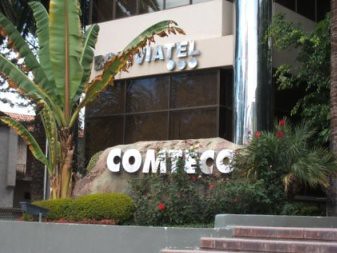
In Bolivia, a national incumbent fixed line operator - Entel - does exist. This was renationalised by the left wing administration of President Evo Morales just weeks after we visited the company's Santa Cruz office. My understanding, however, is that the majority of the country's PSTN subscriptions are with the numerous cooperatives. We felt it could be useful to visit some of these. In Santa Cruz, we were received at the offices of COTAS (CooperativadeTelecomunicaciones Santa Cruz). In Cochabamba, we visited the headquarters of COMTECO (CooperativadeTelecomunicaciones Cochabamba).
Entel offices, Santa Cruz, Bolivia
As with the visit to Paraguay's COPACO described in the most recent previous article here, conversations with the representatives of these cooperatives (about how they might contribute to our conference) were strikingly unlike those we had at the offices of private sector telcoselsewhere in South America. Again, the themes to which our contacts warmed most readily were around bridging the digital divide and extending the availability of affordable basic services to poorer and more remotely located users.
While none of these cooperatives have constructed mobile networks, COTAS is able to compete in the cellular space. Bolivia is a rare case of a South American country in which even one MVNOs is in existence - and that MVNO is the mobile offering of COTAS, hosted by Nuevatel (which operates under the Viva brand), an MNO once owned by John Stanton's Western Wireless.
Nuevatel HQ, Santa Cruz, Bolivia
That COTAS is able to operate as an MVNO is not due to any particular encouragement on the part of the Bolivian telecoms regulator. A 2006 report from Diamond Consultants asked whether conditions, at that time, were right for the emergence of MVNOs in India. I'll admit that I haven't yet read this report very carefully, but perhaps it's safe to guess the answer might have been 'no'. After all, as recently as March this year, DevelopingTelecomsWatchwas reporting on continued regulatory wrangles which looked set to delay the market entry of MVNOs in India. As part of its discussion, the Diamond Consultants report makes remarks about the state of play for MVNOs in some other markets around the world. Bolivia is observed to be a market in which the regulator has discouraged MVNOs, with policies "primarily driven by the low penetration of mobile services and the low geographic reach of the network." It is further argued that "low ARPUs meant that the discount MVNO model was not viable" The regulator's stance is described as seeing "brand and data service-oriented MVNOs... encroaching on the already limited capacity" Rather than encourage MVNOs to emerge, the report observes, the Bolivian regulator "stepped in and provided incentives to mobile network operators to improve capacity and coverage". Despite this, COTASMovil was launched in mid-2002 to complement the cooperative's existing portfolio of fixed voice, ADSL and cable TV services.
The report puts Argentina in the same category as Bolivia - markets in which the entry of MVNOs is discouraged by regulatory agencies. Despite this, MVNO services have been launched there. As with Bolivia, this has been done by telecoms cooperatives.
Now, according to TeleGeography, a federation of telecoms coops, Fecosur, is planning to expand the reach of these mobile services, expecting to extend coverage to around 150 cities and municipalities across the country within four or five months. According to the federation’s president, Antonio Roncoroni, the service is already provided in 14 cities throughout the country under the 'Nuestro' banner. Fecosur and another body, Fecotel, jointly represent around 300 telecoms cooperatives across the country.
Having mused here more than once in the past about Latin America's cooperatives and about telcos renationalised by left-of-centre governments - and about how these organisations appear to operate a little differently from those for whom shareholder value is a key consideration - it will be interesting to observe whether this new mobile offering will have any very significant impact on the Argentinean market.
Others who finds the telecoms coops of Latin America at all interesting might like to look over a scholarly paper (dated 2005) from the The Journal of Community Informatics which I found recently and which rounds up the history of the Argentinean cooperatives quite nicely.
As the English winter draws in, thoughts of sunny days touring Latin America's telcos in the balmy days of April 2008 are quite attractive. Hence these musings today.
In April 2008, your humble scribe had the very great pleasure of visiting four South American countries on behalf of events and business information company Informa Telecoms & Media. The purpose of the trip was to drum up additional support for the Americas Com conference and exhibition, held annually, and usually attracting a few hundred telecoms sector execs from around the Western Hemisphere.
While exhibitors, sponsors, delegates and supporting industry associations seemed to be broadly happy, it was beyond dispute that assembling a crowd which really represented the majority of the countries to the south of the USA was a challenging task. Various venues had been tried over the years - and each time, the location had a significant bearing on the size and diversity of the crowd. Mexican venues made for a group of participants drawn largely from that country, from the Caribbean islands and from some Central American markets. To host the event in BuenosAires was to ensure that the group would consist largely of Argentineans and others from the Conosur region, the most prosperous segment of the South American continent. In both of these scenarios, delegates from the less affluent Andean countries would be rather more thin on the ground.
South America's largest and most populous country by far is, of course, Brazil. Iterations of Americas Com held in that country's most amazingly attractive conference location, Rio deJaneiro, did very well in terms of delegate numbers. Brazilian delegates - who quite rarely seemed inclined to travel in good numbers to venues outside their home country - were so numerous in Rio that a particular difficulty arose, however.
It was perfectly possible to lure a decent contingent of influential delegates from Spanish speaking countries to a conference and exhibition in Rio. For exhibitors and sponsors, however, picking them out from among the massively larger group of Brazilians could be challenging. It was tough, then, to create the perception of having assembled a genuinely multinational delegate audience.
It was with this in mind, and with the 2008 version of Americas Com scheduled once again for Rio, that a two-man delegation set out in April that year for meetings with a varied group of telecoms operators around South America. The week-long tour took in Venezuela, Bolivia, Paraguay and Argentina. Only the last of these had ever really been a source of significant numbers of senior delegates prepared to travel to our event when it was held outside their own country.
For someone who whose previous trips to South America had all been to Brazil, I found this to be a fascinating opportunity. In many ways, it felt as if the only thing these four very different countries have in common is that the official language is Spanish. Walking the streets and having meetings in BuenosAires struck me as being a very similar experience to what one might expect in a southern European country - Spain, Portugal or perhaps Italy. Venezuela and Bolivia were strikingly different places - the people, the climate, the infrastructure: a different world.
Paraguay was, to me at least, the really unknown quantity - a country of which I knew very little aside from recollecting the name of its erstwhile dictator, Alfredo Stroessner and a those of a couple of its notable footballers, Messrs. Santa Cruz and Chilavert.
My colleague (translator/interpreter/fixer) and I did the rounds of the mobile operator HQ buildings in Asuncion. These varied a bit in terms of how expensively they were decorated, but the offices were not vastly different in arrangement or atmosphere to ones you might visit almost anywhere in the world. We were, however, on the way to airport, to visit an HQ which looked and felt rather different.
On our travels around the seemingly quite sleepy Paraguayan capital, it became clear that the local telecoms scene was a close-knit community. Having already been shown around town by a helpful local driver who seemed to know personally everyone with whom we had a scheduled meeting, we had a nice piece of luck on our visit to one of the MNOs. The gentleman with whom we met was able to open doors at one of the organisations where we did not have an appointment fixed up. This introduction, then, led to a meeting with the GerenteComercial of COPACO (CorporaciónParaguayadeComunicaciones), the state-owned incumbent wireline operator.
Informa's Americas region event had only recently expanded its remit from a gathering purely of GSM mobile operators. Part of our task was to increase the diversity of the audience not only in terms of countries represented but also in terms of aiming for a much broader range of telecoms businesses attending the show - fixed/mobile; state sector/private sector; involving delegates from the cable sector.
So it was wonderful to have the opportunity to visit companies in these target segments and something of an eye-opener to have conversations with the leaders of public sector operators (we also visited CANTV in Venezuela) and telecoms cooperatives, of which we managed to visit two in Bolivia.
What was novel for us was discussing the proposed themes of presentations these companies might offer at our event and hearing of topics quite different from the ones we had heard discussed by private sector GSM operators in previous iterations of the conference.
COPACO HQ, Asuncion.
COPACO, which we managed to visit just ahead of our flight to the next stop on the tour, was no exception. Our host, who was exceptionally generous with him time, was most animated when talking about how his organisation was striving to extend the availability of services to under-connected settlements. During this conversation, I couldn't help being struck by how this gentleman's language varied from what I was used to hearing at such meetings and at conferences. I don't recall hearing the terms 'EBITDA', 'shareholder value', 'market share', 'ARPU' or their Spanish equivalents during our chat. Our surroundings, too, were different. COPACO HQ lacked expensively designed marketing materials and branding. We entered through a hall in which customers could make payments. The scene there, to me at least, was somewhat reminiscent of a local government office in the UK - but before our local authorities were made to organise their activities along more commercial lines.
With this memorable discussion in mind, then, it was interesting for me to learn this week, via TeleGeography, that Millicom Cellular International-owned Tigo Paraguay has been awarded a contract to deploy mobile services in four under-served departments of the country, helping CONATEL, the national telecoms regulatory agency, achieve its universal service targets. Under the deal, Tigo will roll out networks to 35 municipalities where cellular services are currently unavailable and the Government will provide funding of around USD1.04 million to support the network deployment. In total, according to the TeleGeography item, the project is expected to cost around USD1.6 million and benefit around 20,000 Paraguayans in remote areas. The private sector, then, has a role to play in meeting some of the challenges discussed by my host on our visit to COPACO HQ last year.
COPACO itself, meanwhile, continues to harbour ambitions of entering the mobile services market. At present, according to the World Cellular Information Service, that market (the mobile penetration rate of which is 85.45%) is split as follows:
According to a recent TeleGeography story, COPACO expects to join this list by mid-2010. With my visit to the company's HQ in mind, I'll be interested to see how their mobile offering fares in competition with the existing cellcos.
Beeline Cambodia: late entrant doing battle in a fierce tariffs war
DevelopingTelecomsWatch depends on the indispensable PhnomPenh Post for news of all things Cambodian, quoting that organ quite liberally, for example, when donning a flak jacket to report on the mobile price war which has been gripping the southeast Asian country for months.
It was also via that esteemed news outlet that DTWlearned this week that the Cambodian Government has tired of waiting for the country's numerous cellcos to end to their damaging tariffs battle. A long-awaited edict setting minimum tariffs was signed by the Government last Friday, telecoms Minister So Khun is quoted as saying.
"We offered free-market principles, but operators kept having conflicts with one another, so the government needs to have a hand in it," So Khun said. The government will suspend the licence of any operators that violate the minimum tariff set by the edict, he added.
The Cambodian mobile market is currently contested by no less than nineMNOs. If there is another country with a population under 15 million whose cellular sector is split so many ways, it does not spring immediately to mind. Of that crowd of cellcos, one, so far, has reacted positively to the imposition of a minimum tariff regime. The PhnomPenh Post quotes Simon Perkins, CEO of Axiata-controlled Hello, who says he supports the initiative "to bring some structure to the telecom tariffs, in the absence of the usual competition guidelines and rules that exist in a lot of markets".
This decision, of course, comes too late for Millicom International Cellular, which announced in July that its three Asian operations (in SriLanka and Laos as well as in Cambodia) were to be reclassified as assets held for sale. The Luxembourg-headquartered mobile group cited problems around ongoing profitability in these Asian markets as a key reason for selling up and focusing its efforts on its African and Latin American properties. As DTWreported in the summer, Millicom CEO Mikael Grahne appeared to attribute much of the blame for deteriorating profits at Cellcard, the Cambodian cellco in which Millicom has a 58.4% stake, to the disruptive market-entry strategies of latecomers to the country's mobile arena. The same DTW piece, however, noted that another major shareholder in Cellcard does not agree with Millicom's assertion that this is negatively impacting profitability: "[There are] no concerns on profitability from our side," said Mark Hanna, CFO of Royal Group, which owns a 38.5% stake in the cellco, denying in July that margins had become tighter.
Such was the confidence of the Royal Group in this assertion that the local Cambodian conglomerate agreed to acquire Millicom's stake in Cellcard. This confidence also seems to be shared now by the Royal Group's bankers. According to a Bloomberg article earlier this month, Royal Group has hired Standard Bank Group Ltd. and Australia & New Zealand Banking Group Ltd. to arrange an 18-month bridging loan to help with the purchase of Millicom's share of the MNO.
The appetite of the Cambodian authorities for intervention in the mobile market does not end with tariff control.
Again, we are indebted to the PhnomPenh Post, this time for coverage of a debate around mobile network sharing in Cambodia.
Last month, the newspaper carried news of Minister So Khun calling for the country's MNOs to share infrastructure. So Khun said the initiative would avoid duplication of infrastructure, thereby reducing costs across the sector, as well as moderating the effect that mobile base stations are having on their surroundings.
"We do not want to see too many antennas dotted along roads in the future," said the Minister. Perhaps it would be too sarcastic to respond by asking "So why did you license nine mobile operators in a country of that size?"
Given that some of these nine are well-established players feeling the effects of the later entry of certain rivals, it seems reasonable to suggest that the response to any mandatory network infrastructure sharing might be rather mixed. As the PhnomPenh Post points out, the operators with an established presence in the market have spent many millions of dollars on infrastructure as part of their efforts to gain competitive advantage.
The Government has shared a draft of a proposed telecoms law one of whose provisions would be to make infrastructure sharing obligatory. The private sector response has been to agree that while there do exist benefits around cost reduction and environmental impact, market forces in Cambodia have not been given sufficient time to work.
"Mandatory facilities sharing will reduce the incentive on operators to build such infrastructure," said these recommendations. "This may result in less than the optimal number of towers being constructed such that when the operators commence infilling their networks to improve coverage and provide better service, they are unable to do so as all tower capacity has been filled."
DevelopingTelecomsWatch finds the mobile market of this particular Asian country to be fascinating. We'll keep watching.
the blogging alter-ego of a globe-trotting Englishman with a professional interest in the telecoms sector in emerging markets and developing countries worldwide.

 Vodafone services: coming soon to a Socialist People's Arab Jamahiriya near you...








 Posts


