News, views and commentary from the telecoms sector across emerging markets and developing countries worldwide
Showing posts with label India. Show all posts

Friday, 21 May 2010

Vodafone to quit Egypt?

This blog is (usually) written on a Sceptred Isle whose citizens (subjects) are currently wondering what life is going to be like under a newly cobbled-together coalition government. This is rather a novel state of affairs because the our electoral system is carefully rigged designed to crown a decisive winner and deliver the 'strong government' we Brits are supposed to favour. Usually this works out fine, with a healthy majority and almost unchecked power conferred upon the winners. There's never even been the need for those 'winners' to command a majority share of the votes cast, much less the support of a majority of those eligible to vote.

During its election campaign, the senior partner in the new government issued dire warnings about the terrible consequences should the voters be unwise enough to elect a hung parliament. The markets, we were warned, would respond unfavourably, leaving our fragile economic recovery exposed to the fall out of their nervousness.

Perhaps this was not too far wide of the mark. The markets continue to be volatile in the early days of this new administration, with Nick Fletcher of the Guardian reporting another bumpy week of trading.

Bucking the current downward trend, however, writes Fletcher, is mobile behemoth Vodafone.

"The mobile phone group has had a busy week", observes Fletcher, winning an Indian 3G licence... and reporting a doubling of annual profits. Today, Fletcher reports, its shares have jumped 2p to 131.45p, making it the biggest riser in a falling FTSE, following reports it plans to sell its 55% stake in its Egyptian business.

One such report, from TeleGeography, suggests that the buyer of Vodafone's controlling stake in the Egyptian MNO may be incumbent wireline operator Telecom Egypt, already the owner of the other 45% of the business.

The article also suggests that if no agreement can be reached between Vodafone and Telecom Egypt, the fixed-line operator may seek another route into the domestic mobile sector, perhaps trying to secure its own wireless licence, should the government, as rumoured, offer a fourth mobile concession in the future.
Share/Save/Bookmark

India's cellcos to balk at mandatory switch to solar-powered equipment?

Solar power: mandatory for India's cellcos?

The green credentials of DevelopingTelecomsWatch are pretty weak - this blog has never dedicated an entire article specifically to an examination of the environmental impact of telecoms technology.

Moreover, the only time DTW has discussed 'green' technologies at length, when wind and solar-powered mobile base stations were evaulated more than a year ago, the focus was mainly on cost benefits for operators. Just a cursory mention was made how such solutions compare favourably - in terms of environmental impact - to diesel-powered generators in the vast numbers of sites where electricty distribution infrastructure is inadequate across developing countries.

Even in terms of the narrower arguments about cost control, last April's article was by no means constructed entirely of fulsome praise for wind-powered and solar-powered mobile network infrastructure. It was noted that while running costs can, of course, look very attractive, the costs of investing in new solar panels and wind turbines themselves are not trivial. DTW also reported concerns on the part of the GSM Association about the results of trials of sun and wind-powered base stations.

Mobile operators, then, mindful of these questions, could presumably be resistant to any attempt to make reliance on these green technologies mandatory.

This is precisely the situation which could be facing cellcos in India.

Writing for India's Economic Times earlier this month, Subhash Narayan asserts that the country's government "may ask telecom companies to install solar panels to generate backup power for cellphone towers, a move that could hurt the sector already troubled by a squeeze in margins."

A proposal being finalised by the Ministry of New and Renewable Energy (MNRE), writes Narayan, "is aimed at containing the use of polluting diesel gensets to provide back-up power" and "could increase the cost of network expansion significantly"

"The green drive will prevent these engines of development (telecom towers) from becoming grave environmental hazards," said an official with MNRE. "We are discussing the proposal with various stakeholders. A cabinet note is proposed to be finalised thereafter to get the clearance for the scheme," the official said, requesting anonymity

Predicatably, the industry response, as reported by Narayan of the Economic Times, is not terrible enthusiatic. "This could significantly impact the margins of companies already under pressure due to rising spectrum cost and the cut-throat competition in the sector," said 'an executive with a large private telco'.

Narayan asserts that the Indian government is not keen on providing any subsidy for solar power equipment, but says it could offer them soft loans under refinancing schemes of Indian Renewable Energy Development Agency.

This skepticism from India notwithstanding, one can still find evidence of cellcos in developing countries going down the green power route. Chinese vendor, ZTE, for example, seems to have encouraged MTN's Cameroonian opco to take delivery of an unspecified number of solar-powered base stations.
Share/Save/Bookmark

Thursday, 6 May 2010

Afrique Occidentale & Centrale Com: De retour au Sénégal par demande générale

The Zain-Bharti transaction: How will West African mobile markets be affected?

Mais non! DevelopingTelecomsWatch has not become a francophone blog. The frenchified title of today's offering is in honour of the fact that a noted West African telecoms conference is, after two years in Nigeria, to be hosted in Senegal in June.

Geopolitically, West Africa is defined by the UN as consisting of: Benin, Burkina Faso, Côte d'Ivoire, Cape Verde, Gambia, Ghana, Guinea, Guinea-Bissau, Liberia, Mali, Mauritania, Niger, Nigeria, Senegal, Sierra Leone and Togo. Of these, just four are countries where English is an official language. Of the others, two are Lusophone states and ten are French-speaking.

The organisers of the aforementioned conference have found that this linguistic diversity in the region creates certain challenges for them. Nigeria, as by far the largest market in West Africa, seemed to be the logical place in which to host the event for the last couple of years. Certainly, relocating the conference to Abuja (from its previous venue of Dakar, Senegal) two years ago paid tremendous dividends in terms of boosted attendance numbers and a good buzz of activity at the 2008 and 2009 iterations of the gathering. This was achieved, however, at the cost of making the event a tad less attractive for delegates from the numerous French-speaking markets. This effect was somewhat mitigated by ensuring that simultaneous English-French translation was available during all conference sessions, but perhaps not as much as was hoped given that this year Informa Telecoms & Media have moved the show back to Dakar again.

Given that delegates from telecoms operators attend for free, Informa monetises its Com World Series events (of which West & Central Africa Com is one) largely by selling sponsorship packages and exhibition space to the telecoms technology vendors that do business with those operators. These vendors will doubtless remain keen on the potential of the large (and fragmented) Nigerian telecoms market and might be concerned about not having a good tradeshow route-to-market to address this now the conference has headed back to Dakar.

With this in mind, I guess, Informa are also running a specifically Nigerian event in Lagos this year. This will make its debut in September.

In the meantime, what can we expect to be discussed at the Dakar gathering?

I guess one hot topic - addressed via offline chitchat if not via presentations and panel discussions - will be the effect of Zain's withdrawal from the region. The Kuwaiti group currently controls opcos in Burkina Faso, Ghana, Niger, Nigeria and Sierra Leone - as well as others in markets elsewhere in sub-Saharan Africa. As discussed ad nauseum in DTW posts passim., all of these are now set to be in the hands of giant Indian cellco Bharti Airtel. DTW's most recent article, mainly a brief exploration of whether India's mobile market is set to consolidate, did a little to talk up the ways in which Bharti Airtel might be able to reinvent Zain Africa by introducing the low-cost business model which it has empoyed on home turf. So let's see how much tougher sub-Saharan markets are set to become for Zain/Bharti's competitors.

This acquistion, however, may yet take a little while longer to conclude. One reason for this could be resistance from the governments of the countries in which the Zain-owned opcos are set to change hands. That said, there have been recent signs of these obstacles being overcome.

Back in March, for example, as reported by India's Economic Times, the Government of Gabon said it "disapproves" of the sale of Zain's Gabonese assets to Bharti Airtel and reserves the right to take "all necessary measures". Late last week, Reuters was reporting that this objection had been resolved.

It will be interesting, then, to see how long it takes to deal with any further problems of this kind. If the difficulties do continue into June, it should be interesting to connect with Tiemoko Coulibaly, Vice President of Zain's Western Africa operations at West & Central Africa Com in Dakar.

There will be many other reasons to attend the event - but connecting with the likes of Mr Coulibaly could be motivation enough for anyone who does business with Zain in Africa and now needs to keep on top of how the change of ownership is set to change the game.
Share/Save/Bookmark

Thursday, 22 April 2010

India: operator space to consolidate while handset market gets more fragmented?

Maarten Pieters: Vodafone India CEO predicts market consolidation

Last week, a broad range of news outlets were carrying the claim that just 31% of the population of India were known to have access to a toilet and 'improved sanitation' in 2008. This is clearly a regrettable state of affairs, with dire consequences for public health, life expectancy and economic development.

Ordinarily, however, it does not follow that the seriousness of an issue always correlates strongly with the willingness of the global media to give it coverage. It was a welcome surprise, then, to see this particular issue given some space even by the website of the thin, brightly coloured newspaper given free at UK railway stations to daily commuters such as myself. After all, this is an organ whose print version dedicates just a few pages to what I would really call 'news' - far more space is given over to celebrity tittletattle and TV listings.

How, then, did this story successfully compete for space even in that kind of context?

The key seems to have been handing the global media an compelling, ready-written headline. The person responsible for doing so in this case appears to be Zafar Adeel, Director of the United Nations University’s Canada-based think-tank, the Institute for Water, Environment and Health.

So how did Dr. Adeel manage to craft a headline sufficiently eye-catching so as to propel this important but unglamorous issue up the news agenda last week? He did so by building it around the assertion that more Indians have access to a mobile phone than to a working toilet. Presumably, the desired effect on readers in Europe and North America was to stimulate a thought process along the following lines: 'More cellphones than toilets? That's crazy! Toilets have been around forever and are one of the most basic facilities expected for a civilised life -  but the mobile phone is a recently invented luxury item.'

Such a characterisation of the mobile device would be understandable when articulated by someone who ticks the following boxes:
  • lives in a wealthy, developed country and has not had the opportunity to see mobile phones being used on the city streets or in the villages of (for example) Kenya, India or Bangladesh
  • is old enough to remember when mobile phones were seen as an expensive status symbol used only by wealthy executives
  • has not thought about how access to communications services can improve the lives of poor people by connecting them with time-saving information and services
Regular readers of this blog, and anyone working in or around the telecoms sector in emerging markets/developing countries, however, would be much less likely to think of mobile phones in this way. They would probably be inclined to realise that is precisely because developing countries have weak infrastructure that the mobile phone has rapidly become a truly vital part of the lives of even very poor people in such nations. Numerous examples of this have been decribed in DTW posts passim. Rather than trawl through all of those, readers might like to look at a nicely succinct round up of observations on this topic, made recently Anand Giridharadas, writing for the New York Times.

Giridharadas observes that there is "a global flowering of innovation on the simple cellphone" and that "from Brazil to India to South Korea and even Afghanistan, people are seeking work via text message; borrowing, lending, and receiving salaries on cellphones; employing their phones as flashlights, televisions and radios." He goes on to assert that "many do all this for peanuts", noting that "in India, Reliance Communications sells handsets for less than [USD] 25, with one-cent-a-minute phone calls across India and one-cent text messages and no monthly charge — while earning fat profits."

Readers of this blog, particularly any working in India's mobile sector, might on one hand take pride in seeing such achievements talked up but may, on the other hand, not fully recognise the idea of an industry revelling in 'fat' profits.

Certainly, the feeling in India may be that at the very low tariff levels referred to by Giridharadas, not all operators may continue to be viable. Sypmathetic to this view is Maarten Pieters, CEO Of Vodafone India. Speaking to the Economic Times last week, Pieters observed: "It’s all about scale because we have very low tariffs here. If you compared the tariffs here, it’s about 10% or what we get in Europe in the Vodafone Group as an average tariff. So, how can you survive as an operator on those low tariffs that is by creating scale and it is very clear that it will not be able for 10 people or 10 operators to create that scale, which means there needs to be some form of consolidation".

Pieters does not expect this consolidation of the mobile market to happen overnight, however, because it would not be facilitated by India's current M&A rules. "So, we first need to see some changes of the rules and then you will probably see consolidation."

Indian mobile operators, then, have to strive for profitability in an extremely tough environment. Quite often, I have heard industry watchers articulate the view that this should equip the country's cellcos very well for meeting the challenges of extracting a profit from developing countries elsewhere in the world. Also out there is the feeling that any Indian MNOs with international ambitions will need to be mindful of quite different challenges they may face.

Writing last month for telecoms.com about the purchase of Zain's African opcos by Bharti Airtel, for example, Matthew Reed observes that "Bharti will be looking to reinvent Zain Africa by introducing the low-cost business model that it has pioneered successfully in India" and "will also be hoping to achieve economies of scale across its Asian and African operations, which together will make it the fifth-largest mobile operator in the world".

Reed does offer words of caution, however, arguing that "operating in Africa does present particular challenges, some of which will be new to Bharti, despite its credentials as an emerging-market operator."

"The takeover of Zain Africa", writes Reed, "will give Bharti operations in 15 different countries, each of which has its own political and regulatory conditions, and some of which present some political risk. The diversity alone will be something new for Bharti, which only had mobile operations in India until it made recent moves into Sri Lanka and Bangladesh."

Reed also observes that while tariffs in Africa have traditonally been rather higher than those Bharti Airtel has to live with on home soil, the giant Indian cellco is entering many African markets at a time when higher levels of competition have more recently been pushing down prices. "In much of sub-Saharan Africa", Reed adds, "the infrastructure is poor and distribution is difficult."

Maarten Pieters of Vodafone India, meanwhile, is almost uniquely well qualified to make predictions about how his company's major competitor is likely to fare as it embarks on its African adventure - between 2003 and 2005, he was the CEO of Celtel International, the collection of African operators acquired by Zain and subsequently sold on to Bharti Airtel. Pieters has also served on the board of Millicom International Cellular, the multinational mobile group whose African assets currently include opcos in Chad, DRC, Ghana, Mauritius, Rwanda, Senegal and Tanzania.

Pieters offers words of encouragement: "Bharti is a very fantastic company. I really admire them. They have done a very good job in India. They have a very good management. If anyone can make a success out of the old Celtel assets, then it’s them. So, I am very happy that they are in good hands."

While, as Pieters argues, consolidation of the Indian mobile operator space may be inevitable, the handset market, conversely, seems to be becoming more fragmented. Priyanka Joshi of the Business Standard writes that "the segment has seen entry of one mobile vendor every month." For the year 2009, Joshi asserts, "new vendors registered a combined market share of 12.3% of the total 101.54 million mobile handset sales."

Examples of new market entrants offered by Joshi include Wynn Telecom. "Starting May this year, writes Joshi, "the company will launch seven dual SIM handsets priced under Rs 5000 and will also get ready to manufacture handsets in India."

Some new entrants, explains Joshi, will build a business around devices tailored to meet the needs of users in India's vast rural areas. Olive Telecommunications  is one example of a company with this strategy.

It will be interesting to observe, then, whether the mobile services and mobile handsets markets do indeed move in these opposite directions - with the former consolidating down to a smaller number of operators of scale and the latter continuing to offer opportunities for innovative new entrants.
Share/Save/Bookmark

Tuesday, 15 December 2009

More musings on a latin t(r)ip

The most recent article here was both a round up of some recent news from Paraguay and a trip down memory lane. I reminisced fondly about an interesting tour of four South American countries which I enjoyed last year. In doing so, I mentioned in passing the two telecoms cooperatives I was able to visit in Bolivia.

LATAM17
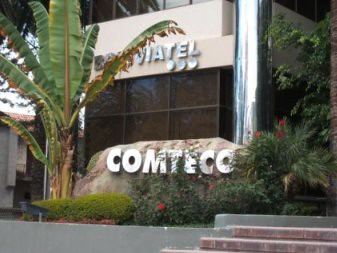
COMTECO HQ, Cochabama Bolivia

As the Bolivia market report from telecoms industry watchers Buddecomm notes, the Andean country is one of South America's poorest and least developed. According to Buddecomm's figures, Bolivia has the continent's lowest mobile penetration and second lowest fixed line teledensity. With regard to the former measure, data from the the World Cellular Information Service supports this claim. WCIS indicates that the country's mobile penetration stood at just 60.08% as of the end of September this year. Most other countries in South America's less affluent northern region show much higher numbers, for example:
  • Venezuela - 105.98%
  • Ecuador - 91.35%
  • Colombia - 83.75%
In the more prosperous Conosur region, the numbers tend to be higher still, for example:
  • Uruguay - 117.10%
  • Argentina - 115.97%
  • Chile - 98.33%
Certainly, Bolivia seemed to be a visibly less affluent country than others I have been able to visit in the region. Although I did spend one night in the capital, La Paz, in order to make an early flight on to Caracas (via Lima), my meetings were elsewhere. The cities I visited were Santa Cruz and Cochabamba. The former city is Bolivia's most populous and is at the heart of the country's economic activity. The latter city is Bolivia's third largest settlement, set in an Andean valley, with a magnificent backdrop of mountain peaks.

As described in the most recent post here, the purpose of my tour around South America was to drum up support for the Americas Com conference and exhibition, the success of which it was one of my tasks to contribute towards until last year. In the other countries I visited, it was sufficient to spend time just in their capital cities, travelling between meetings by taxi. This would not have worked in Bolivia, where in the wireline space, at least, the telecommunications market is highly fragmented.

In Bolivia, a national incumbent fixed line operator - Entel - does exist. This was renationalised by the left wing administration of President Evo Morales just weeks after we visited the company's Santa Cruz office. My understanding, however, is that the majority of the country's PSTN subscriptions are with the numerous cooperatives. We felt it could be useful to visit some of these. In Santa Cruz, we were received at the offices of COTAS (Cooperativa de Telecomunicaciones Santa Cruz). In Cochabamba, we visited the headquarters of COMTECO (Cooperativa de Telecomunicaciones Cochabamba).

LATAM12
Entel offices, Santa Cruz, Bolivia

As with the visit to Paraguay's COPACO described in the most recent previous article here, conversations with the representatives of these cooperatives (about how they might contribute to our conference) were strikingly unlike those we had at the offices of private sector telcos elsewhere in South America. Again, the themes to which our contacts warmed most readily were around bridging the digital divide and extending the availability of affordable basic services to poorer and more remotely located users.

While none of these cooperatives have constructed mobile networks, COTAS is able to compete in the cellular space. Bolivia is a rare case of a South American country in which even one MVNOs is in existence - and that MVNO is the mobile offering of COTAS, hosted by Nuevatel (which operates under the Viva brand), an MNO once owned by John Stanton's Western Wireless.

LATAM14
Nuevatel HQ, Santa Cruz, Bolivia

That COTAS is able to operate as an MVNO is not due to any particular encouragement on the part of the Bolivian telecoms regulator. A 2006 report from Diamond Consultants asked whether conditions, at that time, were right for the emergence of MVNOs in India. I'll admit that I haven't yet read this report very carefully, but perhaps it's safe to guess the answer might have been 'no'. After all, as recently as March this year, DevelopingTelecomsWatch was reporting on continued regulatory wrangles which looked set to delay the market entry of MVNOs in India. As part of its discussion, the Diamond Consultants report makes remarks about the state of play for MVNOs in some other markets around the world. Bolivia is observed to be a market in which the regulator has discouraged MVNOs, with policies "primarily driven by the low penetration of mobile services and the low geographic reach of the network." It is further argued that "low ARPUs meant that the discount MVNO model was not viable" The regulator's stance is described as seeing "brand and data service-oriented MVNOs... encroaching on the already limited capacity" Rather than encourage MVNOs to emerge, the report observes, the Bolivian regulator "stepped in and provided incentives to mobile network operators to improve capacity and coverage". Despite this, COTAS Movil was launched in mid-2002 to complement the cooperative's existing portfolio of fixed voice, ADSL and cable TV services.

The report puts Argentina in the same category as Bolivia - markets in which the entry of MVNOs is discouraged by regulatory agencies. Despite this, MVNO services have been launched there. As with Bolivia, this has been done by telecoms cooperatives.

Now, according to TeleGeography, a federation of telecoms coops, Fecosur, is planning to expand the reach of these mobile services, expecting to extend coverage to around 150 cities and municipalities across the country within four or five months. According to the federation’s president, Antonio Roncoroni, the service is already provided in 14 cities throughout the country under the 'Nuestro' banner. Fecosur and another body, Fecotel, jointly represent around 300 telecoms cooperatives across the country.

Having mused here more than once in the past about Latin America's cooperatives and about telcos renationalised by left-of-centre governments - and about how these organisations appear to operate a little differently from those for whom shareholder value is a key consideration - it will be interesting to observe whether this new mobile offering will have any very significant impact on the Argentinean market.

Others who finds the telecoms coops of Latin America at all interesting might like to look over a scholarly paper (dated 2005) from the The Journal of Community Informatics which I found recently and which rounds up the history of the Argentinean cooperatives quite nicely.

As the English winter draws in, thoughts of sunny days touring Latin America's telcos in the balmy days of April 2008 are quite attractive. Hence these musings today.
Share/Save/Bookmark

Saturday, 14 November 2009

Aptilo Networks positive about prospects for WiMAX in developing countries

Johan Terve, Aptilo Networks:
good opportunities for WiMAX in emerging markets

DevelopingTelecomsWatch was a proud media partner of this year's iteration of the annual Africa Com conference and exhibition held in Cape Town. The event concluded on Thursday this week, wrapping up two days of discussions and networking among the continent's telecoms operators and their business partners from the vendor and systems integrator communities.

One theme explored in some detail at the conference - via a special breakout session - was the question of to what extent WiMAX is gaining traction in Africa.

With this in mind, DTW spoke this week with Johan Terve, VP Marketing at Aptilo Networks, a supplier of pre-integrated management solutions for control of billing, user services and access in WiMAX and Wi-Fi networks. Aptilo Networks had a presence at Africa Com so we were keen to get a sense of whether this was indicative of an upbeat view of the scale of the WiMAX opportunity in Africa - and across developing countries and emerging markets more generally.

For proponents of WiMAX, the emerging markets opportunity may grow in importance - certainly if we are to believe bleak analyses of the technology's ongoing prospects in more developed economies. One such comes from Terry Norman of consulting and research firm Analysys Mason, who in August predicted a difficult time ahead for equipment makers.

Norman believes that "over the last two or three years, WiMAX has gained a strong foothold in developing countries in which there is a need for broadband, but the fixed infrastructure is poor." He feels, however, that these markets offer insufficient growth potential and size "to sustain continued investment from such heavyweights as Cisco Systems, Intel and Motorola without additional sales in the developed markets". Therein lies a problem, argues Norman, because "in the developed markets of Europe and the USA, we see some early signs of a difficult future for WiMAX."

One difficulty could be any reluctance on the part of of leading mobile operators to deploy the technology. Terry Norman writes that in developed European markets, operators are almost certainly upgrading their 3G technologies to 4G LTE in order to match the rising demand for data. Norman draws a connection between leading no leading MNOs hinting that they might adopt WiMAX and the idea that "LTE is imminent."

Johan Terve rejects the notion of that it being "too late" for WiMAX in developed markets. Terve feels that such language would suggest that "this is a race with a single winner". He believes the opposite to be true and that both WiMAX and LTE will co-exist just like xDSL and fiber do in the wired broadband world.

While Terry Norman of Analysys Mason was downbeat about the growth prospects for WiMAX in Europe and US but sounding somewhat positive about the case for the technology in emerging markets, some analysts are more cautious even about the latter opportunity.

A Cellular News article published last month asks whether there really is a big market for WiMAX in the developing countries. The article is built around opinions recently expressed by industry watchers Ovum, who find "that the confluence of several factors including technology cost, coverage, vendor support and service provider choices will limit WiMAX to only a niche technology in the emerging markets, forming part of established fixed and mobile operators' broader broadband access portfolios."

Johan Terve responded to this point by saying that "if they mean that WiMAX technology will be niche based on size, then there is an element of truth in that since in the end LTE will be bigger because of its massive support amongst mobile operators" and because "the industry expects LTE to be a replacement technology for 2G/3G mobile phones as well."

"The WiMAX market does not have the ambition to be a new mobile phone system", argues Terve. "In terms of pure mobile data technologies for portable laptops and mobile Internet devices," he continues, "the two markets will be more equal, and for the 'Wireless DSL' or CPE market WiMAX will probably be larger".

Last month's Cellular News article, however, contends that most emerging markets WiMAX operators currently have thousands, or tens of thousands of subscribers, rather than the hundreds of thousands of subscribers that they planned to have at this stage. DTW asked Johan Terve to what degree he is concerned by these modest numbers.

"We in the vendor community are always far more optimistic in growth projections than the reality," he answered. "The projections of rolled-out LTE networks and subscribers will most likely have to be revised down in the coming quarters. However, there is a big difference between LTE and WiMAX in that the tier 1 mobile operators already have a huge subscriber base just waiting for more bandwidth [and] disappointed with what the current 3G networks have been able to deliver. This will make the LTE ramp-up quicker than it has been for WiMAX having to deploy from scratch. Essentially all larger WiMAX operators are new to market, including Clearwire, PacketOne, Yota and UQ. None of them have the luxury of just adding WiMAX technology to existing cell towers. Are we concerned about WiMAX? No, we are seeing signs now within our customer and prospects base that things are really starting to move. One encouraging factor is, for instance, one of the largest operators in India that is currently deploying Aptilo’s solution. This type of operator tends to scale very quickly in terms of subscriber growth. As a company, we are continuing our multi-wireless support (currently Wi-Fi and WiMAX) and have added LTE to our roadmap to be able to cater to all the help operators need in managing their mobile data traffic."

Where, then, does Aptilo networks see some of the richest opportunities in Africa and in emerging markets more generally?

"We see the greatest opportunities with existing Internet Service Providers and new greenfield challengers in the first phase," says Johan Terve. "We also see a great opportunity with CDMA mobile operators that have hesitated to deploy EV-DO for broadband data services. Their strategy is to keep developing their voice offering in CDMA and then choose between LTE and WiMAX for data. For them LTE is a heavier fork-lift than for 3G operators and WiMAX has the benefit that it is here now, ready to deploy."

Could Terve point to any specific examples of this particular deployment scenario?

"We are currently working with one of our Caribbean CDMA mobile operator customers that will continue with their CDMA for voice and build their data broadband on WiMAX," he responded.

Aptilo Networks, then, is among those continuing to make positive noises about the value WiMAX may be able to add to the communications landscape of emerging markets and developing countries worldwide. It is likely this theme will be revisited when DTW reports on next year's Africa Com event, and it will be interesting to see how far this view has proven to be accurate by that time.
Share/Save/Bookmark

Tuesday, 27 October 2009

Knocked back in Sri Lanka, India's state sector telcos continue to eye international expansion opportunities

BSNL: global ambitions?

DevelopingTelecomsWatch has followed, with some interest, suggestions that India's two major state sector telecoms operators - BSNL and MTNL - might be aiming to become international players.

In September, this blog went on a meandering tour of emerging markets M&A rumours, during which it was mentioned that BSNL's bid for Millicom International Cellular's Sri Lankan MNO had been unsuccessful. Tigo Sri Lanka, as reported more recently here, was eventually acquired by Etisalat of the UAE, in a move which prompted some analysts to express fear for the profitability of the island nation's other mobile operators. These commentators have noted that Etisalat tends to compete fiercely on price when coming late to a cellular market.

In the same September M&A tour, DTW also quoted industry watchers who were warning both BSNL and MTNL to steer clear of reported attempts to acquire a stake in Kuwaiti-owned pan-MEA mobile group Zain. A Mint article by Shauvik Ghosh was referenced, in which an anonymous analyst said that BSNL would be advised not to purchase a stake in Zain. "BSNL has a lot of cash on its books but it lacks the ability to execute," said the mystery man. Not shy of the odd split infinitive, the unknown analyst said "Africa is not a market for an operator to just add some revenue to its balance sheet. They have to first show that they can execute in India with the opportunities already in front of them like broadband and 3G before they can venture into bigger game like Zain." A previous DTW article discussed at some length the view that the two public sector telcos have perhaps not yet demonstrated that ability to "execute in India" to anything like a satisfactory degree.

There is evidence, though, from as recently as mid-October, that BSNL and MTNL have not been deterred by such criticism and that the two companies continues to investigate both the Zain opportunity and other potential foreign adventures.

Writing on 15th October
, Mansi Taneja of the Business Standard reports that a consortium led by Delhi-based Vavasi Group is in discussions with both BSNL MTNL for a majority stake in a special purpose vehicle that is being formed for a bid for Zain.

Taneja quotes "a top source close to the consortium" who has said: "Our talks with BSNL and MTNL are on track, but we don’t have any exclusivity contract with them. We are also holding informal discussions with other telecom companies, including China Mobile, in case talks with BSNL and MTNL do not fructify."

(note to self: attempt to use the word 'fructify' in conversation this week)

Is it unfair on the two Indian operators to venture the suggestion that the giant Chinese cellco might be a far more powerful player to have involved in an audacious bid to acquire operations and subscribers across Africa and the Middle East? Way back in 2002, the Chinese operator stole Vodafone's crown as the world's leading mobile operator in terms of subscriber numbers. Vodafone was subsequently seen to stake out its credentials as the world's largest cellco by revenues. Finally, in September this year, this accolade was also swiped by China Mobile.

If the Vavasi Group does turn out to be more impressed by the credential of the world's most gigantically-huge-mobile-operator-by-every-measurement-ever than by what BSNL and MTNL can bring to a bid for Zain, where else might the two Indian operators look for overseas growth opportunities?

One possibility, again aired by the indispensable Business Standard, is a much more modest foray into Africa, namely the acquisition of a majority stake in Zamtel, the state-owned incumbent telco of Zambia, which competes in the mobile space and is the monopoly fixed-line operator. On 15th September, the Government of the landlocked southern African country announced its intention to part-privatise the telco through the sale of up to 75% of the company’s equity. Industry watchers Buddecomm, in their Zambia profile, describe the country's wireline infrastructure as "at a very low level of development, which in turn has impeded growth in the Internet sector." Zamtel's monopoly in this space is set to be threatened, continues the Buddecomm profile, which notes that "the country’s ISPs are rolling out wireless broadband networks, which will also position them as competitors in the telecoms sector once VoIP is fully liberalised", something which is meant to be "a key component in Zambia's new ICT Policy."

The Zambia Development Agency (ZDA) makes a more upbeat assessment of the Zamtel fixed network, claiming that it connects all major population centres and is undergoing a substantial upgrade, with over 80% of switching infrastructure now digital, and DSL capacity being rolled out. The ZDA claims that Zamtel’s primary fixed-wireless network is also being upgraded and expanded, with coverage and capacity expected to more than double within the next twelve months. Zamtel’s secondary fixed-wireless network, based on WIMAX technology, is designed to cover the whole of metropolitan Lusaka, and is scheduled to go live during 2010, says the ZDA.

In the mobile space, Zamtel lags a long way behind its competitors in terms of market share. The stats, estimated for September 2009 by WCIS look like this:
  1. Zain Zambia - 72.17%
  2. MTN Zambia - 23.12%
  3. Zamtel - 4.71%
Zamtel, then, is struggling to compete effectively against two of Africa's leading mobile groups. There is, however, room for all competitors to grow, with Zambia's mobile penetration rate currently standing at just under 33% according to WCIS. Whether BSNL and MTNL are ideally suited to improving the fortunes of the company, however, could be questioned in light of some of the criticisms aired here about their performance in their home market of India. According to the Business Standard, the two public sector telcos are joined by seven other companies or consortia from in having successfully prequalified to participate in a bid for Zamtel.

Should both the relatively modest aspiration of buying control of Zambia's incumbent operator and the rather more grand designs on Zain both come to nought, MTNL and BSNL do appear to have ambitions to establish a presence in other regions.

Again, I am indebted to India's Business Standard for an update. According to an article of October 23rd, the two operators, along with the Vavasi Group, are planning to set up new operations in Russian and western Europe.

Under this deal, the article states, Vavasi "is acquiring frequency spectrum and licences for Russia and several western European countries" and "the same [special purpose vehicle] that is being formed to acquire a majority stake in Zain will be used to invest in the Russian operations."

Confirming the development, a senior Vavasi executive is quoted as having said: "We are in the process of acquiring a licence for the new generation (NG)-1 technology and have applied in Russia and four other European countries."

This is where I betray the fact that I am not an engineer by wondering about this "NG-1 technology". What is it? The Business Standard article claims that "NG-1 technology is an alternative to GSM and CDMA and was developed in the US universities" and that "Vavasi claims that the network needs lower capital expenditure as well as operating expenses."

I'll hold my hands up. This is a new one on me.

An inspection of the Vavasi website reveals that NG-1 is a proprietary wireless access technology the company has developed itself and which it claims "understands the need of both rural and urban areas". Impressive sounding claims are also made for the spectrum efficiency and eco-friendly credentials of the technology.

NG-1 sounds wonderful - but can proprietary kit from India really prevail against global standards such as WiMAX, HSPA and LTE?

Some grand claims, then, are being made about the ambitions of India's two major state sector telecoms companies. Some of these claims seem to be articulated rather more loudly by the Vavasi Group than by the telcos themselves. I wonder how much there is in all of this. Can two operators that have attracted much criticism in their home market really be set to emerge as global players?


Share/Save/Bookmark

Tuesday, 6 October 2009

India: cut-price tariffs squeezing margins and causing telecoms stocks to tumble

A number of articles here have wrestled with the question of optimum pricing for mobile operators in emerging markets. Some of these have focused on the case of Millicom International Cellular selling its three Asian operations, having cited, in the case of Cambodia, the challenges of maintaining healthy profitability in the face of the highly aggressive market entry strategies of new entrants.

This week a price war fought amongst telcos elsewhere in Asia has cause a slide in the value of their stocks:

The lady speaking in this clip contends that the first shots in this Indian tariff war were fired by Aircel (India's seventh largest cellco by market share) and Tata DoCoMo, the recently-launched GSM proposition from CDMA operator Tata Teleservices, arising out of its strategic alliance with Japanese mobile giant NTT DoCoMo.

In August, Tata DoCoMo made waves by becoming the first Indian mobile brand to offer per-second billing. Some media sources contend that impressive subscriber additions for the operator since then have been largely driven by the attractiveness of this innovation. Surya R Kannoth of the Economic Times, writing today, says that the most aggressive response to this yet has been from Reliance Communications, which on Monday announced a flat, cheap per-minute lifetime tariff for all calls - local, NLD, on-net, offnet, inbound/outbound roaming - made by both CDMA and GSM prepaid users. All this comes for no monthly fixed charge, but with a one-time set up fee of Rs48 (around one US Dollar).

The commentator speaking in the video clip above argues that this tariff causes the spread between cost per minute and revenue per minute to become very narrow, "and that would hurt profitability going forward." She goes on to quote analysts who say that the tariff is "disruptive" and will put pressure on major players such as Vodafone, Idea Cellular and Bharti Airtel, whose Chairman said today that prices in India have hit rock bottom. In light of the damage to share prices seen this week, investors in the various mobile operators will doubtless be hoping that this really is the case.

Bharti Airtel is getting consecutive mentions at DTW, having been the subject of the most recent article here, which was about how India's market-leading cellco has been disappointed by a second failed attempt to create a merger with the Africa and Middle East cellular powerhouse MTN of South Africa. In that article I mentioned, not for the first time, that there exists the belief that competitive pressures in its home market will continue to make the exploration of foreign investment opportunities very compelling for Bharti Airtel. I take today's news of a price war and tumbling telecoms stocks to be a pretty solid plank for that argument. I also reported the opinion that the Indian cellco might want to take a good look into acquiring some or all of the assets of Zain, the availability of which has been talked up for months now, not least here at DTW, where we ran a whole series of articles on speculation around the Kuwaiti group's possible exit from Africa.

A Business Standard article run on Saturday contends that not only is this a likely scenario, but that the Indian operator may need to take on its one-time suitor in a battle to take control of Zain. This idea seems to be drawn from the fact that last month, MTN CEO Phutuma Nhleko told journalists that his company would consider buying the African assets of Zain if the deal with Bharti Airtel did not go through.

Share/Save/Bookmark

Friday, 4 September 2009

India update: loose ends from previous entries

MTS: Russian cellco's Indian operation - world's first CDMA2000 1x Advanced deployment

The time is fast approaching when I'll want to revisit the twists and turns of the much-discussed MTN-Bharti Airtel merger. That mooted deal, though, is by no means the only interesting story on the Indian telecoms scene so in the meantime I'd like to follow up on a number of issues covered in previous articles here.

Early last month, this blog discussed the desire of Scandinavian telecoms firm Telenor firm to secure a controlling interest in the Indian mobile operator in which it is a shareholder. A stumbling block had been the concerns of the country's security agencies, worried about the Norwegian firm's links to Bangladesh and Pakistan, both neighbouring states inside which terrorist attacks on Indian targets have been planned. When DTW last picked up this story, it looked as though a solution might be on offer - in the form of the transaction being approved on the condition that none of the staff who have worked at Telenor's Pakistan operation will be employed in India. Courtesy of India's Economic Times, I learned yesterday that this proposal to allow Telenor to increase its stake in Unitech Wireless has been sent to the Indian cabinet for approval. Doubtless the Norwegian firm will be hopeful of a positive outcome.

Another recent India-focused DTW article explored how the Government's security fears may be set to affect other telecoms businesses. That piece mentioned the case of ByCell, a Russian-backed firm that has been prevented from entering the Indian mobile services market, with security concerns about the company and its shareholders being the deal-breaker.

Now, another Indian telecoms firm with links to Russia is also the subject of worries over foreign ownership rules. Sistema Shyam Teleservice (now branded MTS India), a CDMA cellco in which Russian conglomerate Sistema has a controlling stake, has been asked to seek fresh approval for its wholly-owned subsidiary Shyam Internet Services, an ISP. According to an Economic Times article yesterday, the subsidiary never secured the mandatory Foreign Investment Promotion Board (FIPB) approval.

The article states that the issue came to light when the cellco's ISP subsidiary, which currently offers services only in Rajasthan, sought approval from the Department of Telecommunications (DoT) to be a pan-India player. MTS India has reportedly told the DoT that since FIPB had previously approved Sistema's 74% stake in the company, it was therefore "assumed that this approval covered all wholly-owned subsidiaries." MTS representatives seem to be confident that this issue can be resolved quickly and without much fuss, but it's worth pointing out that this is not the first time the cellco has run into trouble over failure to obtain FIPB clearances.

Early last year, according to the Economic Times piece, Sistema grew its stake in the Indian mobile operator to 73.97% despite only having got FIPB approval for a stake of 51%. This was resolved, but perhaps the Sistema people will be hoping that these trangressions have not tried the patience of the Indian authorities too far.

On the mobile side, MTS India remains a vigorous proponent of CDMA technology as a good fit for the country. On Tuesday, the operator announced its membership of the CDMA Development Group (CDG), the international consortium of CDMA service providers, manufacturers, application developers and content providers whose roles are to ensure interoperability among systems and encourage the adoption of CDMA2000 wireless technology worldwide. The previous day, the cellco had announced its plan to adopt 1X Advanced technology to support its growth plans. An announcement about the completion and publication of specifications for CDMA2000 1x Advanced was only made last month, so MTS India's claim to be the first service provider in the world to offer this "future-ready technology" seems credible.

CDMA2000 1x Advanced is intended to enable best-in-class and simultaneous voice and high speed EV-DO data services. MTS India CEO Vsevolod Rozanov says "with a need to offer uncompromising, seamless call connectivity with fewer call drops, and data services at ever faster speeds, operators are in search of solutions that utilize limited spectrum more efficiently, to be able to support a larger subscriber-base on it. 1X Advanced is designed to meet both these needs and will help MTS to significantly increase its capacity to provide outstandingly clear voice quality to its growing subscriber base."

This operator, then, seems bullish about the prospects for its advanced services. Last month, DTW covered the apparently less successful efforts of India's two major state-owned telecoms businesses to compete in that space. That article noted that both BSNL and MTNL have registered very low subscriber numbers for their 3G offerings, failing to capitalise on the first-mover advantage they should be enjoying - India's private sector mobile operators continue to wait for oft-delayed licence auctions to take place. I am not sure to what degree high handset prices have been a barrier to consumer adoption of the state sector telcos' 3G services - in previous articles here, it has been noted that the two state-owned companies have a rather lower ARPU subscriber base than some of their private sector rivals. If the price of devices is a major stumbling block, MTNL will be hoping that its recently launched own brand 3G handset - priced at around USD 110 - will have a positive impact.

MTNL is also looking to develop its 3G play in partnership with franchisees, whose role will be to acquire, serve and retain customers and provide customer care, according to a Business Standard article of 16th July. Two interested parties have emerged - Virgin Mobile and Spice Group. The former is well known globally for its MVNOs in the UK, Australia, Canada, France, South Africa and the USA. The Virgin Mobile brand has also been present in India for a little while, with services offered via the CDMA and GSM networks of Tata Teleservices.

Whether the franchise route will turn out to be the best way forward for MTNL remains to be seen. The DTW article which covered the public sector telcos failing to sell good numbers of 3G subscriptions also mentioned the criticism BSNL has received for selecting the franchising model for its WiMAX deployment. A vocal critic was the WiMAX Forum's top representative in India, who has asked the telco to consider how much revenue it may be foregoing by employing this approach.

This criticism, then, implies that the franchisee in this arrangement can make a tidy sum. Perhaps with this in mind, and presumably encouraged by its existing arrangement with BSNL, wireless solutions provider Harris Stratex is eyeing a role in MTNL's WiMAX franchisee project, according to Thomas K. Thomas of Business Line, writing recently.

In the case of 3G mobile services, perhaps MTNL's management would be encouraged by how successful Virgin Mobile has been in the UK and be attracted to the idea of working with a company whose brand value can prove very attractive for consumers. That said, in April this blog discussed how much less successful the Virgin Mobile MVNO in South Africa has been. In terms of market maturity (measured by mobile penetration), Virgin Mobile South Africa made its debut rather later than its UK counterpart had done some years before, thereby finding itself needing to win custom away from the incumbent MNOs. I don't have figures to hand, but I daresay that here in the UK, the Virgin-branded MVNO was the first supplier of mobile services to many of the customers it signed up. In India, mobile penetration might look attractively low to Virgin Mobile, causing the group to hopeful about experiencing growth more akin to the UK scenario than the frustrating South African one. I wonder, however, how strong an affinity for the Virgin brand exists in the minds of Indian consumers. Here in the UK, the brand is associated with a plethora of other products and services and its founder, the charismatic Sir Richard Branson, is often described as one of this country's most admired citizens. Does this brand resonate much more strongly here in Britain than, say, India?

It remains to be seen whether these franchising deals or the launch of new devices will do much to improve the fortunes of India's two ailing state sector telcos. For Amit Gupta of telecoms and IT advisory firm Ovum, none of this is as important as the need to privatise both BSNL and MTNL. In a recent opinion piece, he argues that "political intervention, a bureaucratic culture and pre-liberalization mindset are the root causes for BSNL and MTNL’s poor performance". Even with control handed to new investors, argues Gupta, "the challenge to transform BSNL and MTNL from state owned sick companies into customer centric service providers will be daunting". He feels that "due to the size and complexity of these companies, it won't be possible for an outsider to manage change without the cooperation of the existing employees", which could be tricky if we believe the argument that "at the same time, investors will have to cut the flab from a bloated workforce." These concerns notwithstanding, Gupta continues, "privatization is the only economically viable option" if these companies are to be saved from "their eventual demise."

Amit Gupta argues against the value of the Indian Government merely divesting stakes in the two operators while retaining control. He feels that this is inadequate. I imagine, then, that he would warn off any potential bidders for minority stakes in either opco. One such might be the giant US telco AT&T, which is reportedly considering a bid for a chunk of BSNL.

I've written so much about India on this blog since February that I daresay other loose ends from previous entries may need tying up soon. Watch this space. The next article on India may well zero on that mega-merger whose developments have rumbled on all summer.
Share/Save/Bookmark

Friday, 14 August 2009

WiMAX and 3G trials and tribulations for India's public sector telcos


'India Week' here at DevelopingTelecomsWatch concludes with a round up of views on the prospects for the country's public sector telecoms enterprises.

State-owned telco MTNL is one company somewhat keen to experiment with WiMAX, but is also keen to mitigate the risks and reduce costs through a proposed partnership with another organisation.

Writing for the Economic Times on Saturday, Joji Thomas Philip explains that the public sector operator has invited global telecoms businesses to set up and run its Delhi and Mumbai WiMAX operations on a franchisee basis for a six-year period. If a willing partner is found, MTNL plans to enter into a revenue sharing agreement with the successful bidder. Philip writes that the contract will be reviewed every two years and can be terminated if the franchisee partner does not meet prescribed targets. MTNL wants to work together with the winning bidder when working out strategies for advertising, marketing and promoting the broadband services, and wants those services to carry the MTNL brand. Execution on the sales and market side, along with the business of credit checking customers will be the prime responsibility of the bidder. MTNL, on the other hand, wishes to retain responsibility for fixing tariffs. While there will be room for consulation with its partner, MTNL's word will be final on this issue, the company has said.

How attractive is this opportunity? This may depend on interested parties' views of where WiMAX fits into India's evolving communications landscape. Any prospective bidders who envisage strong demand for a mobile WiMAX service, for example, may encouter words of warning - even from the CEO of the one company already offering WiMAX-based services on a franchisee model.

San Francisco-headquartered Soma Networks, is a supplier of WiMAX base stations, CPE and a multimedia application system designed to provide essential software elements for broadband service providers - support for simultaneous multimedia applications; integration with third-party, IP-based billing and provisioning; interoperability with IMS infrastructures.

A former colleague of mine, Ken Wieland of Informa Telecoms & Media, recently summarised the deal struck between Soma Networks and BSNL, India's other major state-owned telecoms operator back in January 2008. Writing for the telecoms.com portal, Ken notes that BSNL uses Soma Networks as a mobile WiMAX franchisee in the three circles (regions) of Goa, Andhra Pradesh and Maharashtra. Under the franchise arrangement, Ken writes, Soma Networks pays for the WiMAX equipment in exchange for access to BSNL infrastructure (such as tower sites and backhaul facilities). A revenue-sharing deal is also in place as part of the arrangement, with a 70-30 split in favour of the kit-maker.

Soma Networks CEO Yatish Pathak, in an interview with Business Line last month, argued that the mobile WiMAX opportunity in India is probably quite limited, at least in the short term.

"One of the reasons that Soma Networks chose to use WiMAX 802.16e-2005 technology, also called Mobile WiMAX, is that it supports mobile broadband as well as [having] the capability to provide wireless broadband to homes and offices," Pathak told Business Line. "However, its application depends on the context and availability of competing technologies. In an emerging market such as India with vast areas under-served due to lack of wired infrastructure or due to sub-optimal DSL connections, the best use of WiMAX today is to deliver broadband to the homes and businesses that have no broadband, or poor broadband connectivity."

"Using WiMAX as a mobile broadband application is better suited for developed, more mature markets that have high data consumption," Pathak asserted. "Classic examples are Tokyo and Korea."

Pathak can see the business case for broadband service providers opting to use WiMAX to target the Indian laptop user market, saying that "then it will simply be a service such as EV-DO, but with higher data rates." The Soma Networks CEO believes that India's existing mobile operators will continue to evolve their network towards LTE to address their customers' evolving mobile broadband needs. He feels that cellcos might opt for WiMAX deployments in select high traffic business districts and cities to address the enterprise market. However, Pathak does not envisage any Indian MNO deciding to use WiMAX for mobile data on cellphones, arguing that such a service would require the operator to invest in and run two separate networks - an FDD network for 3G and a TDD network for WiMAX. Besides, he continues, the service would require dual mode phones, and the support for two different types of radios would make the handsets cost-prohibitive for Indian consumers, "until there is service acceptance and we see economies of scale."

Soma Networks, is, then, in Pathak's words, currently focused on the delivery of a "broadband data service that optimises the use of bandwidth link to wirelessly deliver a megabit-rate experience within the comforts of a fixed location, such as home or office," notwithstanding the fact that the company's technology, used for rollouts in India for BSNL, "supports mobility even today". It is BSNL's prerogative, Pathak states, to make a decision depending on its business model and strategy on when it wants to extend the mobility features to consumers.

Pathak feels that "going for mobility from day one is a very ambitious plan and requires massive investments." He told Business Line that broadband penetration across the three circles (total population 240 million) served by Soma Networks and BSNL is currently just 0.5%. Even if this rises to 3% over the next three years, he says, we are still talking of very small volumes to justify that kind of investment, given the low ARPU numbers in India.

"In my opinion," Pathak says, "a prudent approach is to focus on Wireless DSL market where there is a huge pent-up demand. This helps us deploy in a scalable manner without making billion dollar investments before any revenue starts accruing. By phasing the rollouts, we lower costs and risks to achieve rapid ROI and then scale up the investments to stitch the coverage areas to offer mobility."

BSNL, however, does not seem to share Mr. Prakha's cautious view about the prospects for mobile WiMAX. Earlier this month, wireless solutions provider Harris Stratex announced an agreement to supply mobile WiMAX technology to the Indian telco. Under the multi-year contract, run the announcement, Harris Stratex will supply its StarMAX™ WiMAX solution to extend BSNL’s public wireless access network to provide high-speed wireless mobility services to enterprise and retail customers in urban areas across the southern Indian state of Kerala, the country's fourth largest telecommunications market. Financial details were not provided in the announcement, but media coverage indicates that this is another franchising model arrangement.

This has presumably not met with the full approval of global trade and standard body the WiMAX Forum, whose regional Honorary Chairman for India, C.S. Rao, in June asked BSNL to avoid further use of the franchisee model.

"While adopting the franchisee model, we feel that BSNL is losing out on the opportunity of racing ahead of the private players in this space," said Rao, who argued that if the state-owned telco deployed networks itself, this would result in revenues amounting to about USD 1.2 billion annually. In the franchisee model, argues Rao, BSNL would only get about USD 500 million per annum.

That public sector telcos BSNL and MTNL are the ones dominating WiMAX news from India at present is due to the period of exclusivity the two organisations have had in this space. As James Middleton, another former Informa Telecoms & Media colleague of mine, observed in February, BSNL also has a first-to-market advantage when it comes to BWA (broadband wireless access) spectrum. While the BWA auctions are scheduled to take place the same time as the 3G licence awards, BSNL is already sitting on a chunk of pan-Indian 20MHz spectrum in the 2.5GHz band, for which it does not have to pay until the auctions take place. BSNL’s 20MHz of BWA spectrum will cost the state-owned operator the same as the highest amount paid for the three remaining 20MHz BWA licences that will be up for auction, two in the 2.3GHz frequency band and another at 2.5GHz. Whether BSNL can be said to have made of the most of this advantageous position seems debatable in light of the low broadband penetration figures and conservative-sounding projections offered by Yatish Pathak of Soma Networks.

BSNL and MTNL have also gained first-to-market advantage in the 3G space, again not having to make payment for spectrum until private sector operators are involved in an auction. As with the BWA auction, and as noted in a Wall Street Journal article today, the two public sector operators will have to pay the Government an amount equal to the highest bid in that auction, the date of which the article only predicts in the vaguest terms, i.e. "later this year."

The state-owned operators may have got into the 3G space ahead of their rival cellcos, but I'm not sure they can be said to have "enjoyed" first-mover advantage. In Tuesday's piece about Mobile Number Portability, we heard from Rajiv Sharma of HSBC Securities, who warned the public sector telcos not to make significant further investments in 3G mobile technology and from Alok Shende of Ascentius Consulting, who believes that the below-industry ARPU recorded by MTNL and BSNL reflects that the companies have attracted price-sensitive, low-MOU subscribers who do not use VAS and do not gain from the enhanced capabilities of a 3G offering. We noted reports that in the six months since its 3G launch, BSNL has acquired just 10,733 subscribers and that the figure for MTNL is said to stand at a mere 902, an average of just 150 per month across Mumbai and Delhi, considered the two most lucrative 3G markets in India.

It is in the context of these extremely modest 3G subscriber numbers that I'd like to consider an Asia Times article written this week by Kunal Kumar Kundu of consulting and IT services firm InfoSys. This - which is a summary of the writer's personal opinions - is nothing short of a withering analysis of BSNL, a company Kundu describes as showing "signs of sickness." Kundu feels that India's largest fixed-line telco looks set to go the way of struggling government-run Air India, "which has had to crawl cap in hand for a state bailout to survive."

For Kundu, "the signs of sickness are all too obvious, led by bloated payroll costs." He states that BSNL's salaries now account for about 25% of revenue, compared with rival Bharti Airtel's 5%, after rising at an compounded rate of 21.5% per annum between the financial years ending March '02 and March '08. Kundu notes that this far outpaces revenue gains, which in the same period increased at a compounded 5.53% per annum. He also argues that only by earning interest in cash kept idle in bank deposits has BSNL kept out of the red, and reports a deterioration in finances in the year to March 2009. Analysts, says Kundu, are forecasting a loss of between around USD 825 million-1.03 billion as salary costs jump by about USD 500 million.

The company, says Kundu, once regarded as one of the Government's crown jewels, is now one of the top candidates for disinvestment this year. He is especially critical of BSNL's performance in the fixed-line space, where "an abominable quality of service and increased options from the private sector have led to a drastic fall in the company's landline subscriptions."

Whether a proposed merger between BSNL and MTNL would cure these ills remains to be seen - and there may be some wait. A week ago, the Business Standard reported that India's Communications and IT Ministry will decide on the merger between the two state-owned telecom companies only after the listing of the former.

"MTNL is a New York Stock Exchange-listed company, and a merger would not be possible without the listing of BSNL. We will first look at listing BSNL and then will decide on the merger," Union Minister of State for Communications and Information Technology Gurudas Kamat said.

Share/Save/Bookmark